Business automation · 7 min read
How to Build a WhatsApp Missed-Lead Recovery SLA
Define ownership, consent checks, evidence, escalation, testing, and safe human handoff for every WhatsApp enquiry.
By Reji Modiyil · Published 2026-08-10 · Updated 2026-09-21
Direct answer
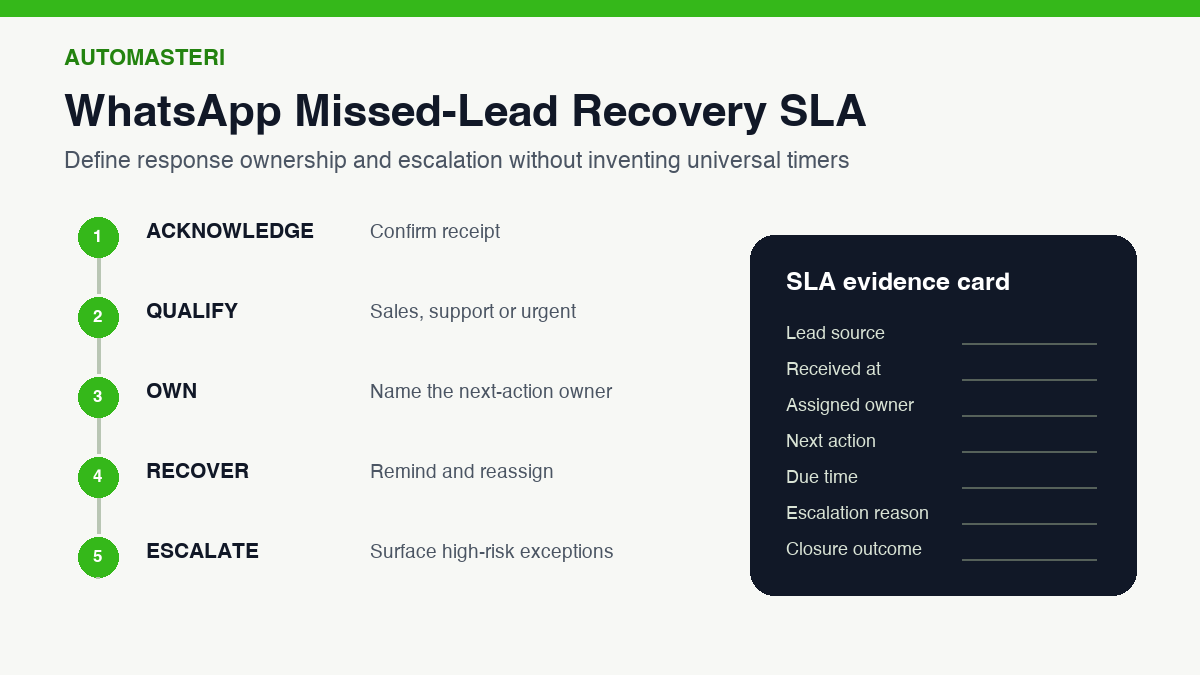
A WhatsApp missed-lead recovery SLA is an internal agreement for what happens after an enquiry arrives. It defines how the team validates the event, records permission and context, assigns one owner, acknowledges the enquiry, sets a next action, detects overdue work, escalates exceptions, and closes the record with evidence.
Do not promise a universal five-minute reply. Choose service windows from actual staffing, business hours, customer urgency, message type, and channel rules. The useful SLA is one the team can prove consistently without replacing judgement with automatic replies.
Separate the events
An inbound message, an outbound message accepted for processing, a sent/delivered/read/failed status, and a human accepting responsibility are different events. Meta's Cloud API webhook reference separates incoming messages from outbound status events and exposes delivery errors. A delivered acknowledgement does not prove a salesperson reviewed the request or set a next action.
Record staffed hours, holidays, languages, request classifications, primary and backup owners, safe acknowledgement scope, and cases that must wait for a person before setting timers.
Use five clocks
- Intake: valid event received through validation, deduplication, and lead creation.
- Acknowledgement: safe intake through an allowed acknowledgement or human reply.
- Ownership: lead creation through acceptance by one named person. Notification is not acceptance.
- Progress: owner acceptance through completion, justified rescheduling, or escalation.
- Recovery: breach through backup takeover, safe closure, or a justified manager exception.
Separate clocks reveal whether intake, ownership, or follow-up failed. One response-time number hides the defect.
Keep a 15-field evidence register
Record event ID; received UTC time; business number/workspace; customer-provided identity; category/language; opt-in or customer-initiated context; acknowledgement type; acknowledgement time/status; primary and backup owner; accepted time; next action/due time; escalation/reason; final status/closure reason; last human review; and retention/deletion date.
Collect only what the enquiry, safety, service evidence, and lawful records require. Restrict access and define retention.
Permission comes first
WhatsApp's Business Messaging Policy says businesses may contact people only after receiving their number and opt-in permission, must honour opt-outs, and may initiate conversations only with approved templates. It permits non-template replies within 24 hours of the person's last message and requires a clear human-escalation path when automation is used.
An overdue task does not authorize a promotional message. First check who initiated the conversation, whether the service window is open, whether a template is required, and whether the content is service-related or marketing.
For UK-directed electronic marketing, the ICO distinguishes requested messages from unsolicited marketing and advises organisations to record what a person agreed to, when, and how. Other jurisdictions differ. This is an operational warning, not legal advice.
Recovery decision tree
- Authentic and complete? If not, quarantine it and do not message.
- Duplicate event? Attach it to the existing record.
- Contact allowed now? If unclear, require human review.
- Owner accepted? If not, assign backup or recovery queue.
- Money, law, health, security, identity, account access, complaint, or unusual promise? Require a person.
- Opt-out, complaint, or request for a person? Stop automation and route appropriately.
A safe acknowledgement identifies the business, confirms what arrived, explains the next step, gives a realistic window, and offers correction and human contact. It must not invent urgency, prices, resolution guarantees, or human review.
Test method
Use labelled test contacts and remove them from reporting. Test staffed and after-hours messages, duplicate events, unknown optional fields, malformed events, delivery failure, ignored assignment, backup takeover, opt-out, human request, complaint/payment issue, and outage replay.
For each case record expected result, actual result, tester, timestamp, evidence, and cleanup. Confirm messages and statuses are not counted as the same event and retries do not create duplicate leads.
AWS operational-excellence guidance recommends observability, anticipated failure, small reversible changes, and learning from events. Here that means visible queue state, bounded retries, manual fallback, and review after mishandled leads.
Review intake completeness, owner acceptance, overdue next actions, and recovery quality weekly. Track opt-outs, failures, duplicates, and high-risk escalations separately. Do not reward fast automatic replies that increase confusion or cleanup.
One-page template
Record scope, staffed window, five targets, primary/backup owners, allowed acknowledgements, template and 24-hour checks, human-review triggers, escalation, evidence, retention, measures, tests, stop conditions, document owner, and review date. Revisit it when staffing, numbers, providers, markets, or message types change.
Reconstruct one recent enquiry today. The first missing evidence field is the first process defect to repair.
AutoMasteri currently provides a free automation-audit route and application-led mentorship. That does not replace legal review, platform approval, staffing, or testing, and it does not guarantee an outcome.
Sources 1. Meta, WhatsApp Cloud API Webhooks Components, accessed 2026-09-18: https://developers.facebook.com/docs/whatsapp/cloud-api/webhooks/components — messages/statuses, IDs, delivery and error evidence. 2. WhatsApp Business Messaging Policy, accessed 2026-09-18: https://business.whatsapp.com/policy — opt-in/out, templates, 24-hour replies, data duties, human escalation. 3. ICO, Electronic and telephone marketing, accessed 2026-09-18: https://ico.org.uk/for-organisations/direct-marketing-and-privacy-and-electronic-communications/guide-to-pecr/electronic-and-telephone-marketing/ — requested vs unsolicited marketing, consent records and withdrawal. 4. AWS, Operational Excellence Pillar, accessed 2026-09-18: https://docs.aws.amazon.com/wellarchitected/latest/operational-excellence-pillar/welcome.html — observability, failure preparation, reversible change and learning.
Build the map before the tools.
Start with the free AutoMasteri automation audit, or apply for a mentor review if you want Reji to review the operating system behind your customer journey.