Business automation · 12 min read
An AI Automation Audit Checklist for Small Businesses
Score workflow value, data, risk, ownership, controls, fallback, evidence, and a safe first AI automation pilot.
By Reji Modiyil · Published 2026-06-25 · Updated 2026-09-21
Direct answer
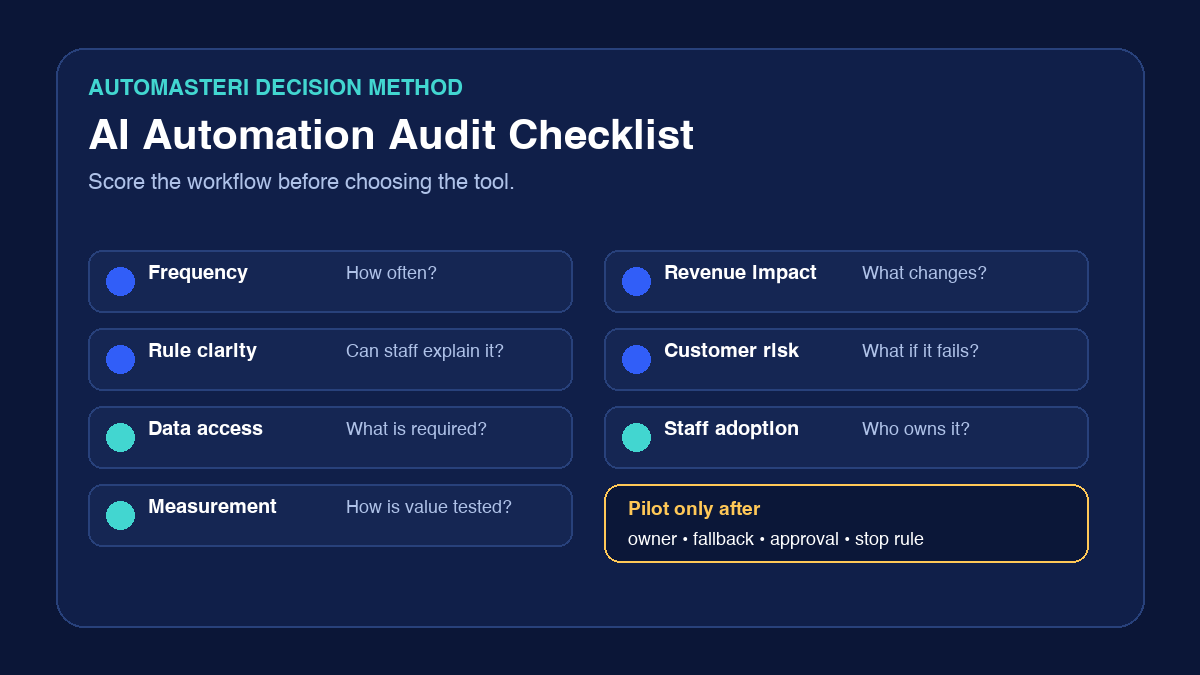
An AI automation audit checks whether a business workflow is valuable, repeatable, measurable, sufficiently documented, supported by usable data, and safe to automate. Start with one workflow, record its current performance, identify the owner and customer risk, map every input and handoff, define human approvals and a fallback, then run a bounded pilot with acceptance evidence and a stop rule.
Good first candidates are frequent, rule-led tasks such as enquiry capture, lead tagging, follow-up reminders, appointment updates, document classification, internal summaries, and owner reporting. Refunds, complaints, identity decisions, final pricing, legal or medical advice, and other high-impact judgements should remain human-controlled unless a much stronger governance and assurance case exists.
Why the audit comes before the tool
A tool demo answers whether software can generate, classify, or move something. It does not answer whether the business should automate that decision, whether the source data is reliable, who owns the result, or what happens when the integration is wrong.
The NIST AI Risk Management Framework treats AI risk as a lifecycle responsibility organised around govern, map, measure, and manage. NIST's Cybersecurity Framework similarly centres governance, identification, protection, detection, response, and recovery. For a small business, the practical lesson is simple: an AI workflow needs an owner, a known operating context, measurable risk, controls, monitoring, and recovery—not only a prompt and an API connection.
AWS's Operational Excellence guidance adds another useful discipline: operate work as code where practical, make frequent small reversible changes, refine procedures, anticipate failure, and learn from operational events. The ICO's AI and data-protection guidance reinforces accountability, data minimisation, transparency, security, and meaningful assessment of risks to people.
These frameworks do not require an SME to build enterprise bureaucracy. They support a short written audit that prevents an attractive prototype from becoming an uncontrolled customer-facing system.
Step 1: Define one workflow and its outcome
Do not audit “AI for the company.” Choose one workflow with a clear start and finish.
Record:
- the event that starts the work;
- the intended customer or business outcome;
- the current owner and backup owner;
- the systems and channels involved;
- the source of truth;
- the normal completion evidence;
- the exceptions that require judgement;
- the present volume, time, cost, delay, and error rate.
Examples include a new WhatsApp enquiry becoming an accepted sales task, an uploaded document becoming an internal classification for review, or a support request becoming a correctly owned ticket with a next update.
If the team cannot agree when the workflow is complete, it is not ready for automation.
Step 2: Score the candidate out of 20
Score each factor from zero to two:
- Frequency — Is the work common enough to justify control and maintenance?
- Business value — Does improvement affect revenue, delivery, support, cost, or owner visibility?
- Rule clarity — Can staff explain the normal decision rules consistently?
- Data readiness — Are required fields available, current, lawful, and sufficiently accurate?
- Ownership — Is one person accountable for the outcome and exceptions?
- Customer risk — Can errors be contained without serious harm, deception, or broken promises?
- Reversibility — Can the change be paused and the last safe process restored?
- Observability — Can the business detect failure, delay, drift, and unexpected cost?
- Human control — Are approvals and escalation points explicit?
- Measurement — Is there a baseline and a decision rule for continuing or stopping?
A score is a triage aid, not proof of safety. A candidate above 15 may be suitable for a bounded pilot if no high-impact red flag exists. A candidate below 11 usually needs process or data cleanup first. Any workflow involving sensitive advice, irreversible action, discrimination risk, account access, money movement, identity, or regulated decisions needs specific expert review regardless of score.
Step 3: Map data and access
List every field the workflow reads, creates, changes, and shares. Mark where the data came from, why it is needed, how long it should be retained, and which people or providers can access it.
Prefer the smallest workable dataset. Enquiry routing may need source, timestamp, customer contact, service interest, language, owner, status, and next action. It rarely needs full payment history, identity documents, private support records, or an unrestricted CRM export.
Check:
- whether customer information may be sent to the proposed AI provider;
- whether production data is being copied into prompts, screenshots, logs, or test accounts;
- whether credentials are stored in a protected system rather than source code;
- whether role and tenant boundaries are enforced server-side;
- whether deletion, correction, retention, and export obligations are supported;
- whether the provider may use submitted data for its own training or service improvement;
- whether the workflow can function with redacted, synthetic, or reference-only data.
If the data path is unclear, stop the pilot before connecting production.
Step 4: Separate assistance from authority
Define exactly what the AI may do.
Lower-risk assistance may include:
- summarising an internal record;
- classifying a request for staff review;
- drafting a reply without sending it;
- extracting bounded fields with validation;
- identifying overdue work;
- preparing an owner report linked to source records.
Higher-risk authority includes sending promises, changing prices or entitlements, approving refunds, closing complaints, modifying accounts, interpreting legal obligations, or deciding something that materially affects a person.
Start with assistance. Require a human to approve customer-facing or consequential actions until the business has evidence that the narrow workflow is accurate, controllable, and appropriate.
Step 5: Design failure and recovery before launch
Write the failure paths while the system is still private.
For each dependency, decide what happens when it is unavailable, slow, duplicated, rate-limited, or returns malformed output. A safe workflow should have:
- a timeout rather than an endless wait;
- an idempotency or duplicate-control rule;
- bounded retries with backoff;
- a queue or manual fallback;
- an honest error instead of false success;
- an escalation owner;
- a rollback or kill switch;
- cleanup instructions for partial writes;
- a record of what happened without unnecessary sensitive payloads.
Automation that cannot fail visibly and recover safely is not ready for live customer work.
Step 6: Establish a baseline and acceptance test
Measure the current process before claiming improvement. Useful baselines include first-response time, missed enquiries, follow-up completion, handling time, correction rate, open exceptions, duplicate records, staff review time, customer complaints, and cost per completed outcome.
Create a small acceptance set that includes normal, incomplete, duplicate, ambiguous, high-risk, and provider-failure cases. State the expected result for every case. Test role boundaries, tenant isolation, approval enforcement, logging, rollback, and cleanup as well as the happy path.
Do not use a successful API response as the only proof. Verify the durable record, customer-visible state, assigned owner, and downstream outcome.
Step 7: Run a bounded first pilot
The first pilot should use one workflow, one accountable owner, a defined user group, a fixed observation window, a known budget, and a limited dataset. Keep irreversible actions and provider sends off until independently approved and tested.
A practical pilot record includes:
- purpose and scope;
- owner and approver;
- test environment and data boundary;
- model/tool/provider version;
- prompt or rule version;
- baseline and target;
- daily usage and cost limits;
- acceptance results;
- incidents and manual corrections;
- customer-risk observations;
- continue, change, pause, or stop decision;
- rollback and cleanup evidence.
Make small reversible changes. If the pilot expands, repeat the audit for the new data, users, authority, and failure modes.
What to automate first
Strong early candidates often include:
- capturing enquiries into one owned record;
- tagging source and service interest;
- assigning and reminding the next-action owner;
- drafting standard acknowledgements for approval;
- detecting missing fields or overdue tasks;
- generating internal summaries with links to source evidence;
- compiling owner dashboards from verified records.
These workflows support people without silently transferring business authority to a model.
What not to automate first
Keep the following human-controlled until a specific assurance case exists:
- refunds, credits, charges, and payment disputes;
- final pricing, contracts, and delivery promises;
- complaints and emotionally sensitive conversations;
- identity, access, KYC, eligibility, or fraud decisions;
- legal, medical, financial, or regulatory advice;
- employee discipline or hiring decisions;
- deletion of customer records;
- publication or outbound messaging without review;
- decisions that cannot be reversed or adequately explained.
How AutoMasteri can fit
AutoMasteri can help an owner map a workflow, identify its evidence and handoffs, choose a bounded first pilot, and define ownership, review, fallback, and measurement. That is mentorship and implementation direction—not a guarantee that every workflow should be automated, that a particular tool will deliver a fixed return, or that customer-risk decisions can run without human accountability.
Use the free automation audit or application route to review one revenue-linked manual workflow before expanding the tool stack.
Source register
- NIST, AI Risk Management Framework — governance and lifecycle risk disciplines: https://www.nist.gov/itl/ai-risk-management-framework (HTTP 200 verified 2026-09-21).
- NIST, Cybersecurity Framework — govern, identify, protect, detect, respond, and recover functions: https://www.nist.gov/cyberframework (HTTP 200 verified 2026-09-21).
- AWS, Well-Architected Operational Excellence Pillar — small reversible changes, anticipating failure, operational learning, and procedure improvement: https://docs.aws.amazon.com/wellarchitected/latest/operational-excellence-pillar/welcome.html (HTTP 200 verified 2026-09-21).
- UK ICO, Guidance on AI and Data Protection — accountability, data minimisation, transparency, security, and risk to individuals: https://ico.org.uk/for-organisations/uk-gdpr-guidance-and-resources/artificial-intelligence/guidance-on-ai-and-data-protection/ (HTTP 200 verified 2026-09-21).
- AutoMasteri homepage, free automation audit, and application routes — product-truth boundary; each returned HTTP 200 on 2026-09-21.
FAQ
What is an AI automation audit?
It is a structured review of a workflow's value, rules, data, ownership, risk, controls, failure paths, measurement, and suitability for a bounded AI-assisted pilot.
Which workflow should a small business audit first?
Choose a frequent, measurable workflow connected to revenue or customer service, with clear rules, reliable data, a named owner, low irreversible risk, and a manual fallback.
Does a high score mean the workflow is safe?
No. The score helps prioritise candidates. Sensitive data, high-impact decisions, legal duties, discrimination risk, or irreversible actions still require specific review and stronger controls.
Should AI send customer messages automatically?
Not by default. Begin with drafting, classification, and routing. Enable sending only after consent, platform policy, approval, error handling, monitoring, and a labelled end-to-end acceptance test are proven.
How long should the first pilot run?
Use a fixed observation window long enough to include normal work and exceptions. The important controls are a small scope, daily oversight, clear limits, and a pre-agreed continue-or-stop decision.
Build the map before the tools.
Start with the free AutoMasteri automation audit, or apply for a mentor review if you want Reji to review the operating system behind your customer journey.